2026-09-17
Autologous Costal Cartilage Rhinoplasty: Precision Tailored to Your Nose

Hello, I am Dr. Jong-seok Lee from ATOP Plastic Surgery.
With such large daily temperature swings lately, I hope you are taking good care of your health.
Having started my clinical practice at ATOP Plastic Surgery, I am greeting you for the first time through this column. Moving forward, I plan to address the questions and concerns patients often have when considering plastic surgery in a clear and comfortable manner.
For our very first topic, I would like to discuss autologous costal cartilage (rib cartilage) rhinoplasty. When contemplating rhinoplasty, almost everyone asks themselves: "What material should I use?" Let's explore when autologous costal cartilage should be considered and what advantages it offers.
While researching rhinoplasty, you come across various materials such as septal cartilage, ear cartilage, autologous costal cartilage, and donated (homologous) costal cartilage. Among these, autologous costal cartilage is a material utilized to create a more stable nasal tip framework thanks to its ample quantity and strong structural support.
In particular, the nasal tip is an area where achieving the desired shape simply by elevating it can be difficult. East Asian noses frequently feature relatively small and weak native cartilage, whereas patient preferences increasingly lean toward a higher nasal tip, making sufficient structural support essential. Furthermore, one must consider not just the appearance immediately after surgery, but also dynamic changes over time, such as tip drooping or loss of projection. Ultimately, when undergoing autologous costal cartilage rhinoplasty, the choice of material and how it is sculpted and designed are of paramount importance.
1. Is Autologous Costal Cartilage Simply "Strong Cartilage"?
Autologous costal cartilage refers to using cartilage harvested from the patient's own rib cage for rhinoplasty.
The greatest advantage of autologous costal cartilage is that an ample quantity can be secured while providing robust structural support. Because septal and ear cartilages are limited in terms of available volume and mechanical strength, their use may be restricted when significant lengthening or strong structural scaffolding is required.
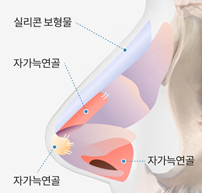
In contrast, autologous costal cartilage can be harvested in generous amounts, making it viable even when native cartilage is deficient—such as in short nose corrections or revision surgeries—and helping to support the nasal tip structure reliably.
2. A Graft Perfectly Customized for You
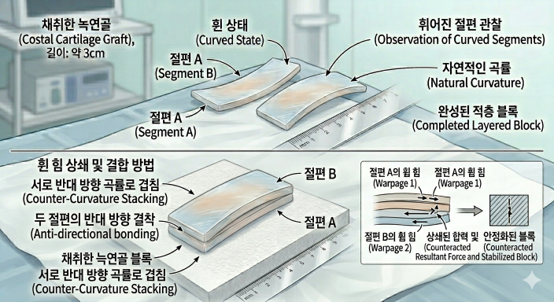
The crucial aspect of autologous rib rhinoplasty is not simply taking rib cartilage and placing it inside the nose.
 Read in another language
11 languages
Read in another language
11 languages
- 🇰🇷 한국어Korean
- 🇺🇸 EnglishEnglish
- 🇨🇳 简体中文Chinese (Simplified)
- 🇹🇼 繁體中文Chinese (Traditional)
- 🇯🇵 日本語Japanese
- 🇲🇳 МонголMongolian
- 🇷🇺 РусскийRussian
- 🇹🇭 ภาษาไทยThai
- 🇮🇩 Bahasa IndonesiaIndonesian
- 🇻🇳 Tiếng ViệtVietnamese
- 🇸🇦 العربيةArabic